A fixed-fee will shouldn't take three hours of your time.
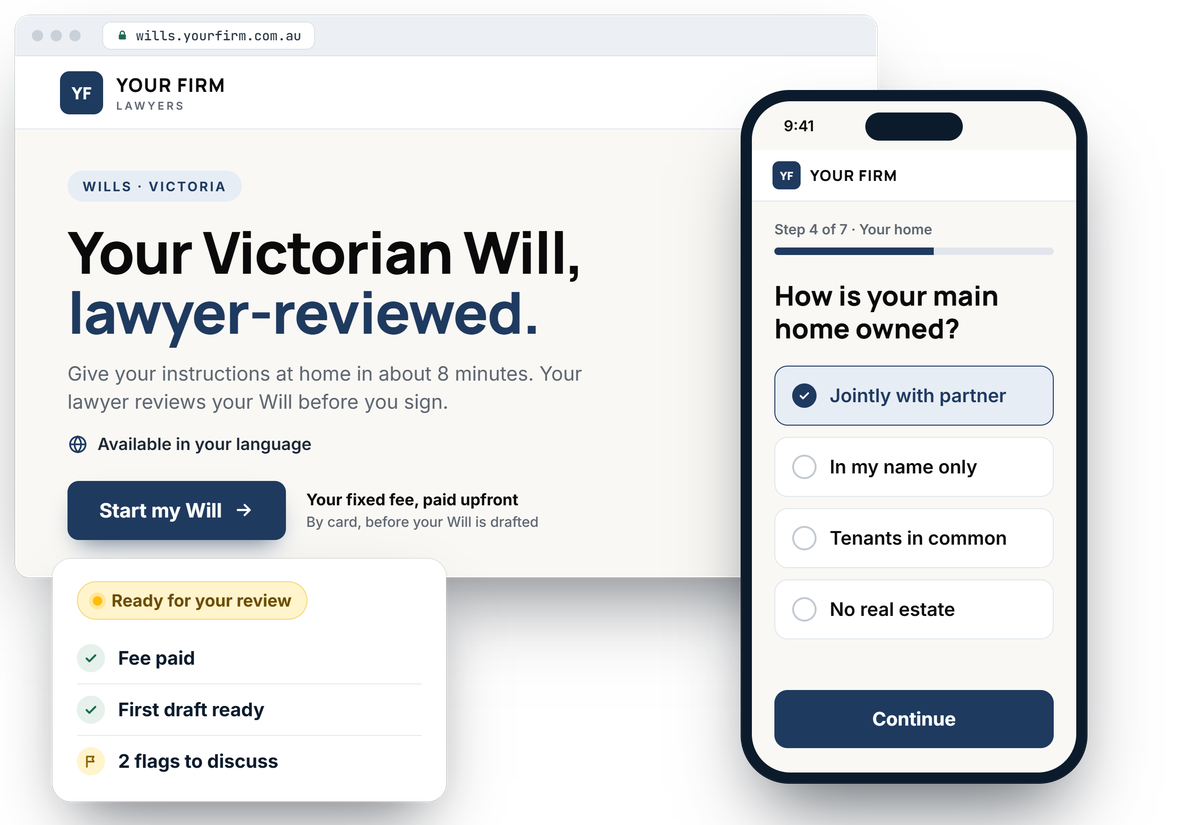
A wills intake on your own website. Clients answer the questions and pay your fixed fee themselves, in their own language. You get a first draft on your precedent, risks flagged, ready to review.
We set it up on your precedent, then your next 3 wills are free. No card, no lock-in. If it doesn't save you time, you owe nothing.
Stop losing money on work that can be automated.
Say your fixed fee is $550 and a will takes 3 hours of your time.
That's about $183 an hour.
Most of those hours go on taking instructions, typing the draft and chasing the fee. That's the part this automates.
Taking instructions, typing the draft, chasing the fee, then advice.
You review the draft and the flags, then give the advice.
Same fee. About 4x the hourly return.
Illustrative: swap in your own fee. On the trial we time your first 3 wills, so you see your own numbers.
And the will stops waiting on your desk until the evening.
A few days ago I 'quoted' $550 for two wills for an elderly couple. … It takes, very conservatively and super efficiently, about 3 hours.
Principal, Jessy Legal (Australian firm), "Drafting Wills", 2023Three steps. You only do the last one.
We put it on your website
On your own domain, like wills.yourfirm.com.au, in your branding, with your precedent and your fixed fee. We do the setup.
Clients answer and pay
At home, on their phone, in their own language. They pay your fixed fee by card before anything is drafted, to the account your trust accountant approves.
So you're paid before you start. No invoices to chase, and no unpaid work if a client goes quiet.
You review the draft and meet them
The first draft on your precedent, with the risks flagged. You check it, give the advice, and they sign.
Live at a Melbourne wills practice. Your precedent, your fee, your name on the will.
What changes on each will.
- The instruction sheet goes home and stalls.
- You type the draft after hours.
- You invoice after signing, then chase it.
- Clients answer at home, in their language.
- The first draft is waiting, risks flagged.
- Your fee is paid before you start.
We set it up on your precedent, then your next 3 wills are free. No card, no lock-in.
Nothing goes to the client until you approve it.
Locked until you approve
Nothing is final until a lawyer signs off.
Risks flagged from the answers
Joint tenancy, super, overseas assets, trusts, anyone left out.
Draft from your precedent, not AI
Fixed rules build it from the answers. AI doesn't write it.
ID and capacity checklist built in
VOI, capacity and undue influence, checked before you approve. Any override is recorded on the matter.
Built around the VLSB+C and LIV guidance.
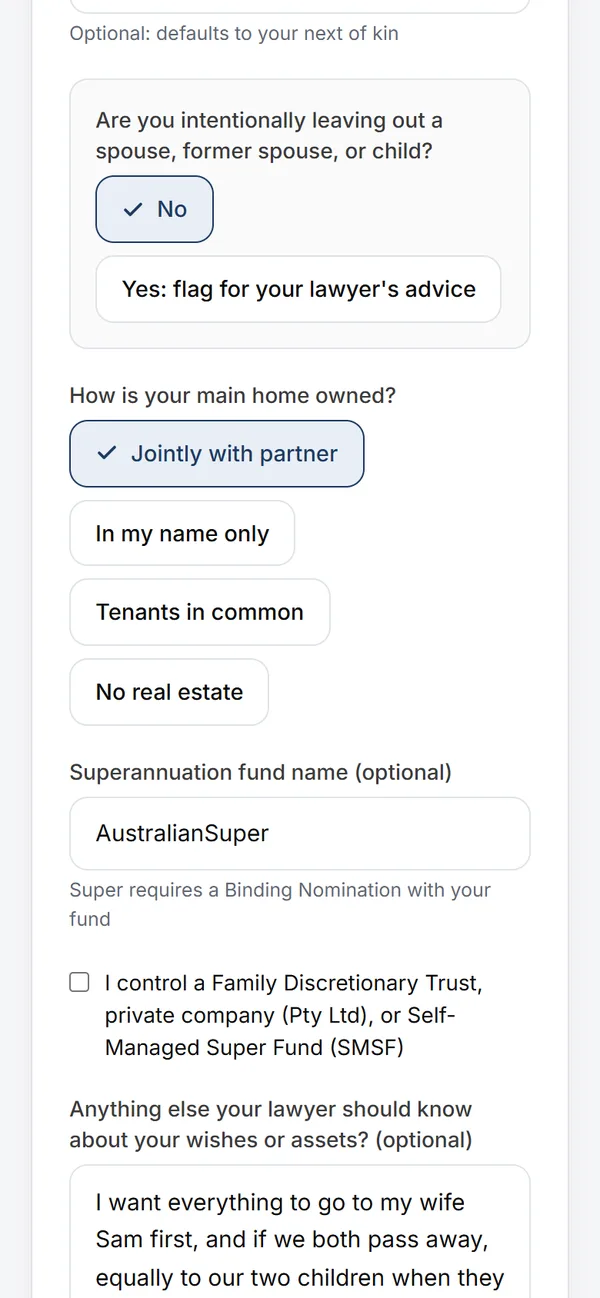
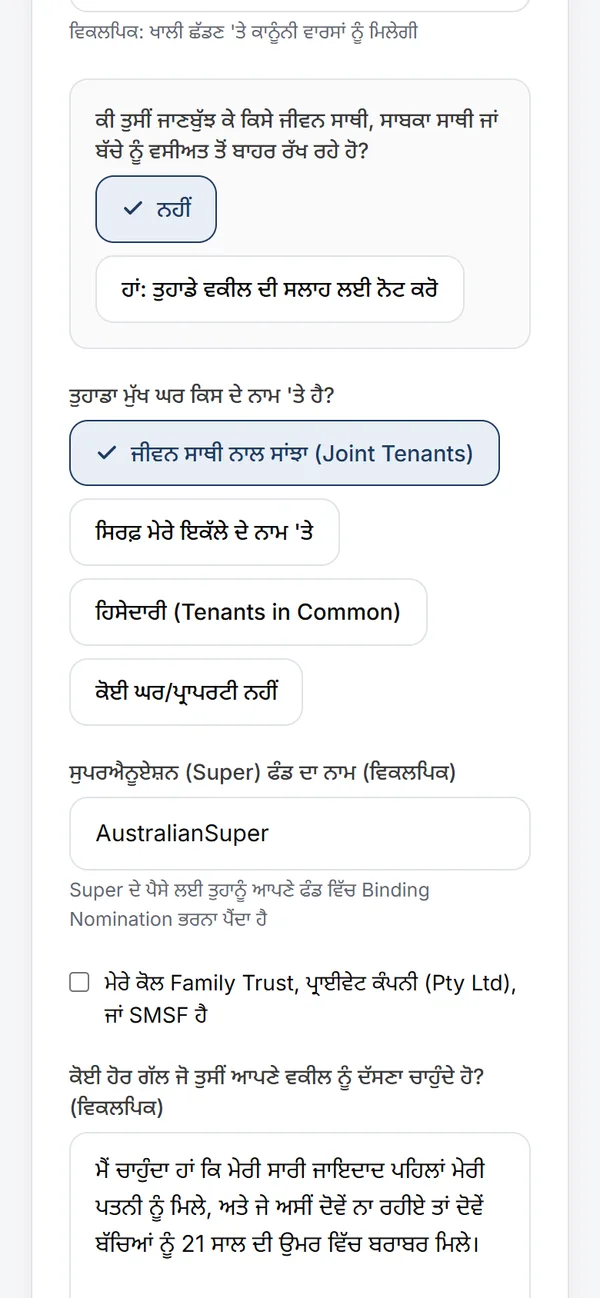
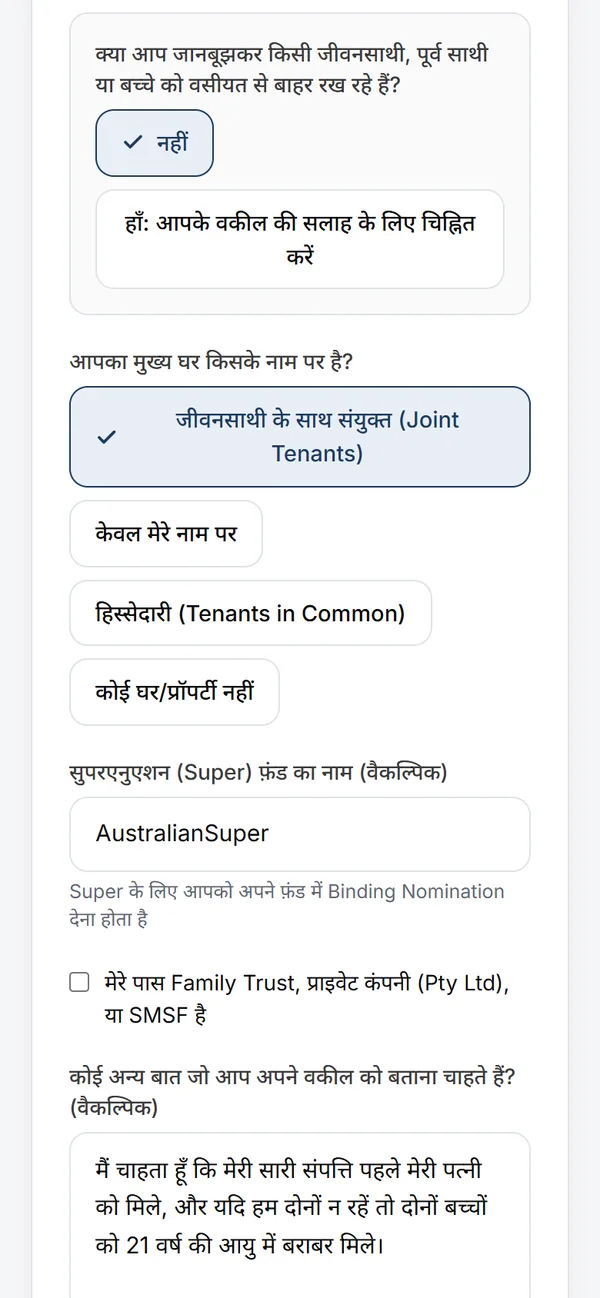
Your clients answer in their own language.
On their own phone, typed or spoken. You review everything in English, with their original words alongside. Below, the same question in English and two example client languages. Need a different language for your clients? Ask on the call.

 +
What we'll cover in 15 minutes
Your precedent and your fee
I'll ask how you take will instructions now, which precedent you use, and what you charge for a simple will.
Your next 3 wills, $0 setup
I set it up on your precedent, with your branding, your fixed fee and your clients' languages. You send the link to your next 3 will clients, and I'm on the phone if anything's unclear.
After the 3 wills
A one-off setup fee plus a fee per completed will, both quoted before you commit. No lock-in contract.
No time saved, no fee. If you stop, your clients' data is returned to you or deleted.
We set it up on your precedent, then your next 3 wills are free. No card, no lock-in.
What principals ask me.
Is this an online will service like Safewill?
No. Your client never gets a will from Firmbrief. They give their instructions and pay your fixed fee through your firm's own page. You get a first draft on your own precedent, you give the advice, you hold the signing appointment, and your firm's name is on it.
I don't trust AI to draft a will. Why trust this?
You shouldn't trust any draft you haven't checked, and you don't have to. The will is assembled from your own precedent and the client's answers by fixed rules, not generated, so the same answers give the same will every time. AI is only used to translate the client's answers into English and transcribe spoken answers. Nothing reaches the client until you approve it.
What about elderly clients, or clients who need an interpreter?
The questionnaire is preparation. It doesn't replace taking instructions. You still see the client alone, confirm their instructions, write your file note, and use an independent interpreter where you need one. For clients who'd rather not use a screen, your office can complete it with them over the phone.
What happens after the first 3 wills?
A one-off setup fee and a fee per completed will, both quoted on the call before you commit. No lock-in contract. If those 3 wills didn't save you time, you owe nothing.
Where does the payment go, and who owns the data?
The fee is paid upfront by card, to the account your trust accountant approves. Card fees, refunds and chargebacks are set up with them before you go live (the trust money rules). The data belongs to your firm, sits behind a lawyer-only login, never goes into public chatbots, and is exported to you then deleted if you stop.
Something else? or WhatsApp Jack.
A family will rely on that will one day. Your time belongs in the advice that gets it right, not the typing.
15-min setup callYour next will client could finish their instructions tonight.
Tell me about your practice, then pick a time. We set it up on your precedent, then your next 3 wills are free.
Book a 15-min setup call
Takes 30 seconds. Then pick a time on the calendar.
Your details are only used to prepare for the call.
We set it up on your precedent, then your next 3 wills are free. No card, no lock-in. A lawyer approves every draft.